Material / Machine
An Embodied vs Synthetic Debate in Creative Education - 17th June 2026
Welcome to the UCA Creative Education Conference 2026, where we explore the meeting point of the Embodied and the Synthetic. This year’s theme, Material/Machine, invites educators, makers, academics, technicians, librarians, leaders, policymakers, and students to interrogate the tensions and harmonies between material intelligence and digital automation.
We are rethinking what it means to learn, make, and create in a cross-disciplinary world where physical and digital processes intertwine. How can we design learning environments that honour embodied practice while embracing synthetic innovation? How do we protect authorship and integrity while expanding participation and aesthetic diversity?
The conference is structured around three strands: Embodied, Machine, and Bridge. Collectively, they invite us to interrogate the pedagogic tools we use and how ways of knowing, making and relating are reshaped when material and synthetic practices meet.
As well as examining the analogue and digital as opposing forces, the three strands invite contributions that examine nuance: where do tactile, situated practices still matter most? Where do automated systems genuinely extend creative possibility? And what happens in messy spaces in between the generative?
Strand 1: Embodied – Material Intelligence in a Digital Age
This strand centres practices where bodies, materials and places do the primary pedagogical work.
Embodied does not mean anti-digital, and instead asks what is lost when material intelligence is treated as optional.
Strand 2: Machine – Synthetic, Automated, Scalable
This strand focuses on synthetic and automated systems: from generative AI and Large Language Models to algorithmic curation, smart tools, and immersive digital platforms.
This strand asks where machines genuinely extend human creativity, and where they risk narrowing it.
Strand 3: Bridge – Hybrid Practices in the Space Between
The Bridge strand explores hybrid, entangled practices where material and machine are co-habit within pedagogic practices.
Why attend?
- Connect with educators and practitioners redefining the future of creative learning
- Share and test your ideas in an open, interdisciplinary environment
- Explore hands-on methods for teaching with both material sensitivity and digital fluency
- Contribute to a growing conversation about integrity, inclusion, and imagination in creative education.
Contact us: creativeedconference@uca.ac.uk
Conference panellists
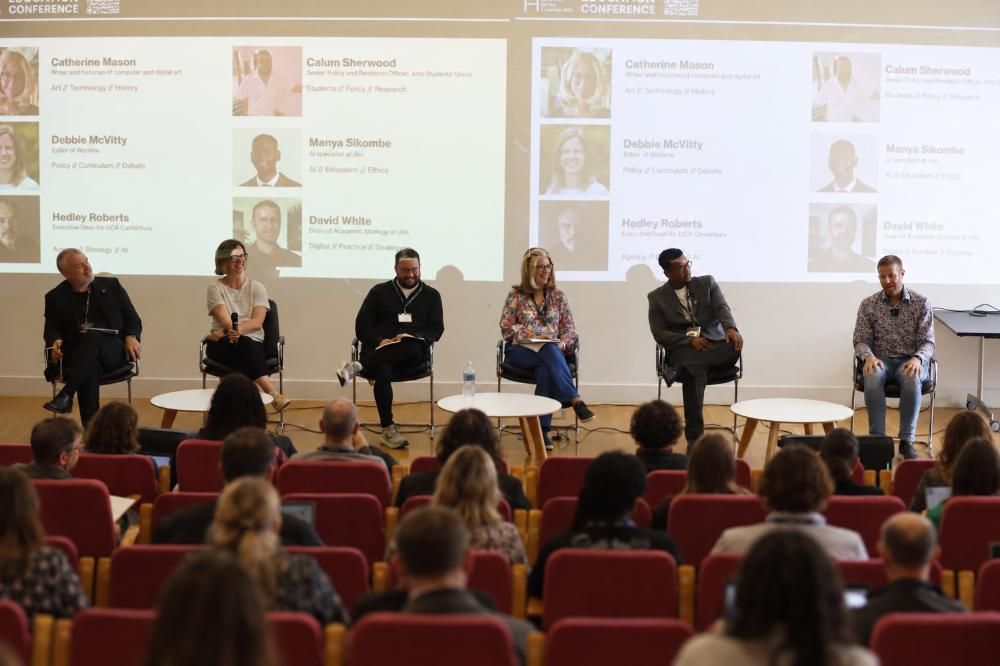
Our conference panellists bring expertise across AI strategy, digital education, art and technology history, and student-centred policy research. Together, they offer a broad set of perspectives to support the opening discussion focusing on current debates around Material/Machine, and ending with the closing panel’s future-facing discussion of the directions, priorities and provocations likely to shape creative education.
Sue Attewell
Sue Attewell is Head of Artificial Intelligence at Jisc, where she co-leads national work to support UK colleges and universities in adopting AI in ways that are responsible, critical, and grounded in real educational practice.
Her work focuses on understanding how AI is reshaping teaching, learning and assessment, particularly in areas where questions of authorship, creativity and integrity are most acute.
She brings sector-wide insight from research with staff and students, alongside practical experience supporting institutions to move from experimentation with AI tools to more thoughtful, sustainable approaches.
Sue is particularly interested in how education can respond to AI not just as a technology, but as a challenge to how we define knowledge, creativity and value in a digital age.
Catherine Mason
Catherine Mason is an internationally recognised expert in the history of art and technology and author of books and articles on the subject. These include the first comprehensive survey of the history of computer arts in Britain - A Computer in the Art Room: the Origins of British Computer Arts 1950-1980, (2008, eBook 2021).
Her latest book Creative Simulations, (Springer 2024) analyses the early activities of the Computer Arts Society through the work of George Mallen, one of the founders of the Society in 1968.
She is a Visiting Research and Knowledge Exchange Fellow in the Department of Computing at Goldsmiths, University of London.
Debbie McVitty
Debbie McVitty is Editor of Wonkhe. As editor, Debbie is responsible for commentary and analysis on higher education across Wonkhe's website, email briefings, podcast and events. Debbie is interested in the social impact of HE, learning, teaching and curriculum, institutional change and innovation, and in bringing to light diverse and under-represented voices in the HE policy debate.
She has previously worked in policy and communications roles at Universities UK, the University of Bedfordshire and the National Union of Students. She is an honorary fellow of the School of Education at the University of Birmingham, a fellow of The Post-18 Project, and a member of the Board of Trustees of the National Institute of Teaching.
Hedley Roberts
Professor Hedley Roberts is Executive Dean at UCA Canterbury, with over 30 years' experience in creative higher education spanning art, design, architecture, media and emerging creative technologies. An artist-scholar whose practice is grounded in philosophy, psychology and the civic purpose of education, his career has encompassed academic strategy, curriculum reform, international partnerships and institutional leadership across the UK, Southeast Asia and Europe. He has led international artist residencies, exhibited and curated internationally, and held visiting professorships. His research interest in Creative Agency Theory underpins a leadership approach that connects pedagogic vision with institutional priorities and cultural insight with structural clarity.
Calum Sherwood
Calum Sherwood is Senior Policy and Research Officer at Arts Students’ Union. His research explores creative education, cultural policy, and how emerging technologies are reshaping artistic practice and creative careers.
Calum is the author of Art or Algorithm?, a study of art and design students’ perspectives on artificial intelligence in creative education, and Craft Your Future, research examining how creative students understand skills, graduate preparedness, and barriers to entering a creative economy being reshaped by automation, AI, and digital creative tools.
Drawing on work across the arts and higher education sectors (including roles with the Arts Council of Northern Ireland, Ravensbourne University, the National Union of Students, and London School of Economics) his work foregrounds student perspectives in debates about the future of creative education.
David White
David White is Dean of Academic Strategy at UAL, leading the Digital Education and Academic Practice teams. Beyond UAL, David is known for the Digital Visitors and Residents continuum (V&R), an approach to understanding how we relate to the digital environment. The V&R mapping activity is used globally in curriculum and staff development sessions. It is also a key instrument in many research projects. Alongside this, David has led a number of national studies which explore the potential of digital in higher education contexts, supporting institutions in the strategic development of teaching practice.
Conference programme, panels and presentations
Wednesday 17 June 2026, 10am – 6pm BST
University for the Creative Arts, 21 Ashley Rd, Epsom KT18 5BE
Material / Machine – An Embodied vs Synthetic Debate in Creative Education
9:30 - 10 - Marketplace/Foyer - M0.16
Registration, tea & coffees
10 - 10:10 - Lecture Theatre - M0.08
Opening address, UCA Creative Education
10:10 - 11:10 - Lecture Theatre - M0.08
Opening panel
Panellists:
- Sue Attewell - Head of AI at JISC
- Catherine Mason – Expert in the history of art and technology
- Debbie McVitty – Editor of Wonkhe
- Hedley Roberts - Executive Dean for UCA Canterbury
- Calum Sherwood - Senior Policy and Research Officer at Arts Students’ Union
- David White - Dean of Academic Strategy at UAL
11:10 - 11:30 - Marketplace/Foyer - M0.16
Tea, coffee and pastries
11:30 - 11:55 - Session 1
Sara Corvino – Radical Resistance or Pedagogical Negligence? A Provocation for Art & Design HE
Resistance to AI in art and design education often appears as a radical stance, yet its meaning shifts with context; without sustained engagement, training and pedagogical frameworks, refusal risks becoming conservative at the expense of students’ future preparedness.
12:00 - 13:00 - Library - LR105
Library workshop 1
Alexander Bell and Emily Anderson - Bibliomancy: engaging with ambiguity through embodied learning in the art library
12:00 - 12:25 - Session 2
Justin Marshall – Hybrid digital/analogue woodworking practices and a Digital Craft Ethos
Through reflecting on a digital/analogue practice-based research project, I am proposing a digital craft ethos which seeks to identify a series of distinctions between an embodied, Pragmatic and craft-oriented approach to engaging with digital tools, and prevailing Instrumental engineering approaches and mindsets.
12:30 - 12:55 - Session 3
Liberty Quinn and Tala Abughdaib - Redefining the Pedagogy of “Error” in Material and Digital Environments
We spend enormous energy teaching students to resolve errors. What if we taught them to use them instead? Error behaves differently depending on where it happens. In material practice, failure resists the quick fix, creating space for reflection. In digital environments, recovery is instant and consequence-free - does that promote surface engagement, or allow students to take risks without fear of irreversible failure?
12:55 - 13:55 - Marketplace/Foyer - M0.16
Lunch
14:00 - 14:25 - Session 4
Laura Clarke – Where the Hand Meets the Machine: Craft, Code and Contemporary Printmaking
This talk discusses the collaboration between artist R James Healy and Master Printer Laura Clarke at the Centre for Print Research, exploring how robotics, algorithms and traditional screen printing techniques were combined to bridge the handmade and the digital.
14:00 - 15:00 - Library - LR105
Library workshop 2
Alexander Bell and Emily Anderson - Bibliomancy: engaging with ambiguity through embodied learning in the art library
14:30 - 14:55 - Session 5
Mads Skovbakke - Outdated or Fundamental? On analogue skills and digital tools in creative HE
The presentation aims to question the dogma around the value of analogue skills in an increasingly digitised art industry and Creative Higher Education landscape. Ultimately it examines the question: Are we still serving our students’ best interest by requiring a student body of digital natives to create physical work for assessment?
15:00 - 15:25 - Session 6
Mila Waldeck – The burden of assessing the feedback: Testing AI-generated feedback in graphic design education
The use of AI for written feedback increases rather than reduces teachers' workload due to the time needed to revise AI-generated inaccuracies and discrepancies between feedback and work submitted.
15:30 - 15:55 - Session 7
Hedley Roberts – Creative Agency and the Spectre of AI: A UCA Response
The spectre of AI haunts the creative university at every level, the student who fears for their authorship and their future, the institution that fears for its data, its accountability, and its governance, while industry asks whether our graduates are ready. This presentation sets out UCA's response across two instruments, a Creative Learning Framework and an AI governance framework, which together move the question upstream to the formation and protection of judgement and accountability, in students and in the institution alike.
16:00 - 17:00 - Lecture Theatre - M0.08
Closing Panel
- Sue Attewell - Head of AI at JISC
- Catherine Mason – Expert in the history of art and technology
- Hedley Roberts – Executive Dean for UCA Canterbury
- Calum Sherwood - Senior Policy and Research Officer at Arts Students’ Union
- David White - Dean of Academic Strategy at UAL
17:00 - 17:10 - Lecture Theatre - M0.08
Closing address, UCA Creative Education
17:10 - 18:00 - Marketplace/Foyer - M0.16
Networking
Booking tickets
Travel and accommodation

The conference will be held on the Epsom Campus at the Business School for Creative Industries.
The address is: 21 Ashley Rd, Epsom KT18 5BE
Please note that there is no parking on Epsom campus, apart from disabled parking. Travelling to campus by car? Learn more about parking at UCA Epsom
By train: The UCA campus is a five-minute walk from Epsom train station. You can get there from London Waterloo or London Victoria. Visit the National Rail website for times and prices.
If travelling from Eurostar and arriving at London St. Pancras International, then take the southbound Victoria Line tube to London Victoria, or change at Oxford Circus (Bakerloo line, southbound) to London Waterloo.
By car: You’ll find our main campus on the outskirts of the town centre, close to the Ashley Centre shopping mall. Please note that there is no parking at the Epsom campus apart from disabled parking. Travelling to campus by car? Learn more about parking at UCA Epsom
The nearest car park to the campus is the Ashley Centre (postcode KT18 5AL), which is about a five-minute walk away. For details of public car parks nearby please visit the Epsom and Ewell Borough Council website.
By foot: Epsom campus is a short 10-minute walk from the town centre and the train station. Please put use the postcode to plan your route: KT18 5BE

There are a number of hotels in Epsom which are within walking distance of the campus.
Travelodge Epsom Central - (10 minute walk)
Premier Inn Epsom Town Centre (13 minute walk)
The Creative Education Conference Archive
In 2025 we explored Innovative Practices in Creative Education, focusing on bold and impactful approaches that shape graduates as critical thinkers, ethical innovators, and agents of change.
We were delighted to welcome Professor Susan Orr as keynote speaker, alongside a distinguished panel: Alan Atlee, Vicki Stott, Stella Fong, Koen Guiking, and Anastasios Maragiannis, who led an inspiring panel discussion on Creativity for a Sustainable Future: Redesigning Learning, Culture, and Industry.
Throughout the day, presenters from around the world shared authentic, practice-based research connecting education with real-world contexts and sustainable futures. Together, they showcased how creative education can empower students, foster collaboration, and drive meaningful innovation.
You can view last years schedule here