

/prod01/channel_13/uca-creative-education/media/microsites/creative-education/creative-education-background.jpg)
THEME: Creative Judgement
Summer 2027
Call for contributions opens October 2026
Creative education depends on judgement.
Students make decisions about materials, methods, meanings, audiences and technologies, and about when a piece of work is ready to leave the studio. Educators judge evidence of learning while working with assessment criteria, disciplinary conventions and different understandings of quality. Technicians, practitioners, peers and partners bring other forms of knowledge through which creative work is interpreted, questioned and developed.
The conditions in which these judgements are made are changing. Generative technologies can produce plausible images, text, sound, moving image and ideas almost instantly. Assessment practices are being reconsidered across higher education, while questions of authorship, process and evidence increasingly overlap with questions of inclusion, agency and academic standards.
Creative Education Conference 2027: Creative Judgement brings together educators, students, technicians, researchers, educational developers, policymakers and creative practitioners to examine how judgement is learned, exercised, negotiated and contested.
Contribute to the conference
We welcome proposals from art, design, architecture, media, performance, craft, fashion, creative business and related disciplines, including work across disciplinary boundaries. Contributions may include research papers, case studies, workshops, provocations, demonstrations, creative interventions and other formats appropriate to the work being presented.
We particularly welcome contributions from students, technicians, professional services colleagues, practitioners and collaborative partners, alongside academic staff and researchers.
Detailed formats, guidance, review information and deadlines will be published when the call opens in October 2026. The conference takes place in summer 2027.
Contact us: creativeedconference@uca.ac.uk
/prod01/channel_13/uca-creative-education/media/microsites/creative-education/DSC05968.jpg)
Explore the conference theme
We have developed four connected questions about how creative judgement is learned, evidenced, authorised and reviewed. You may wish to use these when developing your proposal.
Open each theme to see the questions and areas we invite contributors to explore.
How do students develop judgement?
This theme considers how students develop discernment through making, experimentation, critique, feedback, failure and reflection. Contributions might address studio and workshop learning, material knowledge, technical education, creative risk, uncertainty, peer learning, reflective practice or decisions made with generative technologies.
What counts as evidence of creative learning?
This theme invites work on assessment, feedback, portfolios, rubrics, critique, moderation, academic integrity, authentic and oral assessment, process documentation, and the relationship between creative outcomes and the learning that produced them. What can assessment reasonably claim to know about a student’s creative practice?
Who is authorised to define quality, relevance and value?
This theme considers whose knowledge becomes visible and whose expectations become embedded in curricula, criteria, technologies and professional practices. Contributions might address student voice and co-creation, cultural assumptions, disability and neurodivergence, transnational education, decolonial approaches, algorithmic bias, access, belonging or professional norms.
How do educational communities review and develop their own decisions?
This theme welcomes contributions on professional learning, peer observation and review, Fellowship and professional recognition, educational development, course leadership, quality processes, collaborative teaching, technician education, and how institutions develop shared approaches to teaching and assessment.
The Creative Education Conference Archive
In 2025 we explored Innovative Practices in Creative Education, focusing on bold and impactful approaches that shape graduates as critical thinkers, ethical innovators, and agents of change.
We were delighted to welcome Professor Susan Orr as keynote speaker, alongside a distinguished panel: Alan Atlee, Vicki Stott, Stella Fong, Koen Guiking, and Anastasios Maragiannis, who led an inspiring panel discussion on Creativity for a Sustainable Future: Redesigning Learning, Culture, and Industry.
Throughout the day, presenters from around the world shared authentic, practice-based research connecting education with real-world contexts and sustainable futures. Together, they showcased how creative education can empower students, foster collaboration, and drive meaningful innovation.
You can view last years schedule here
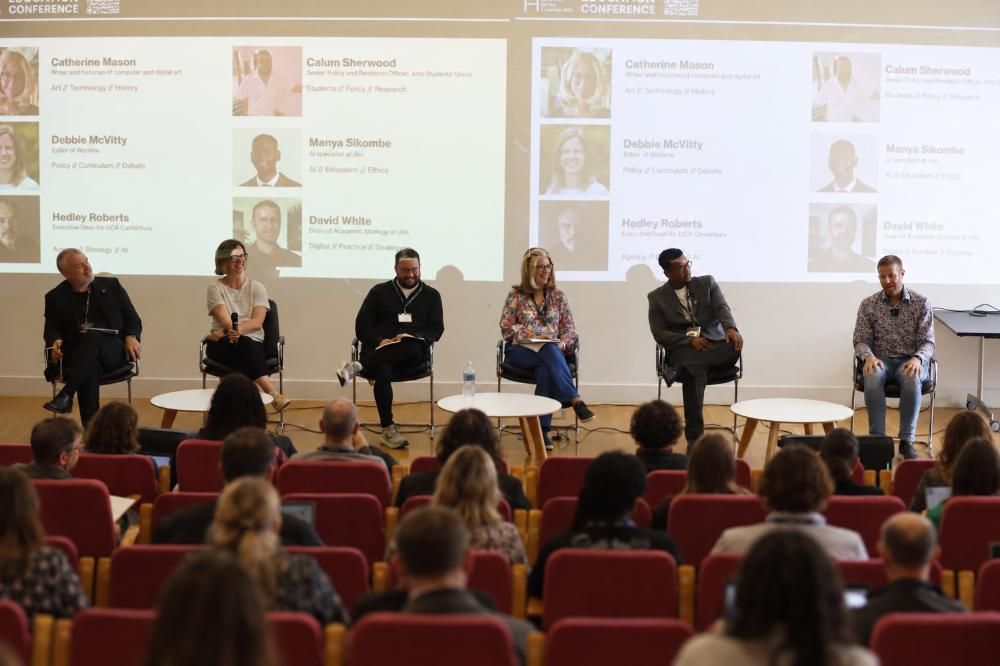
Material / Machine: an embodied versus synthetic debate in creative education.
The 2026 conference explored how material intelligence, digital automation and hybrid practice are reshaping creative education through three connected strands: Embodied, Machine and Bridge.
The full programme and supporting materials are being prepared for publication in the conference archive.